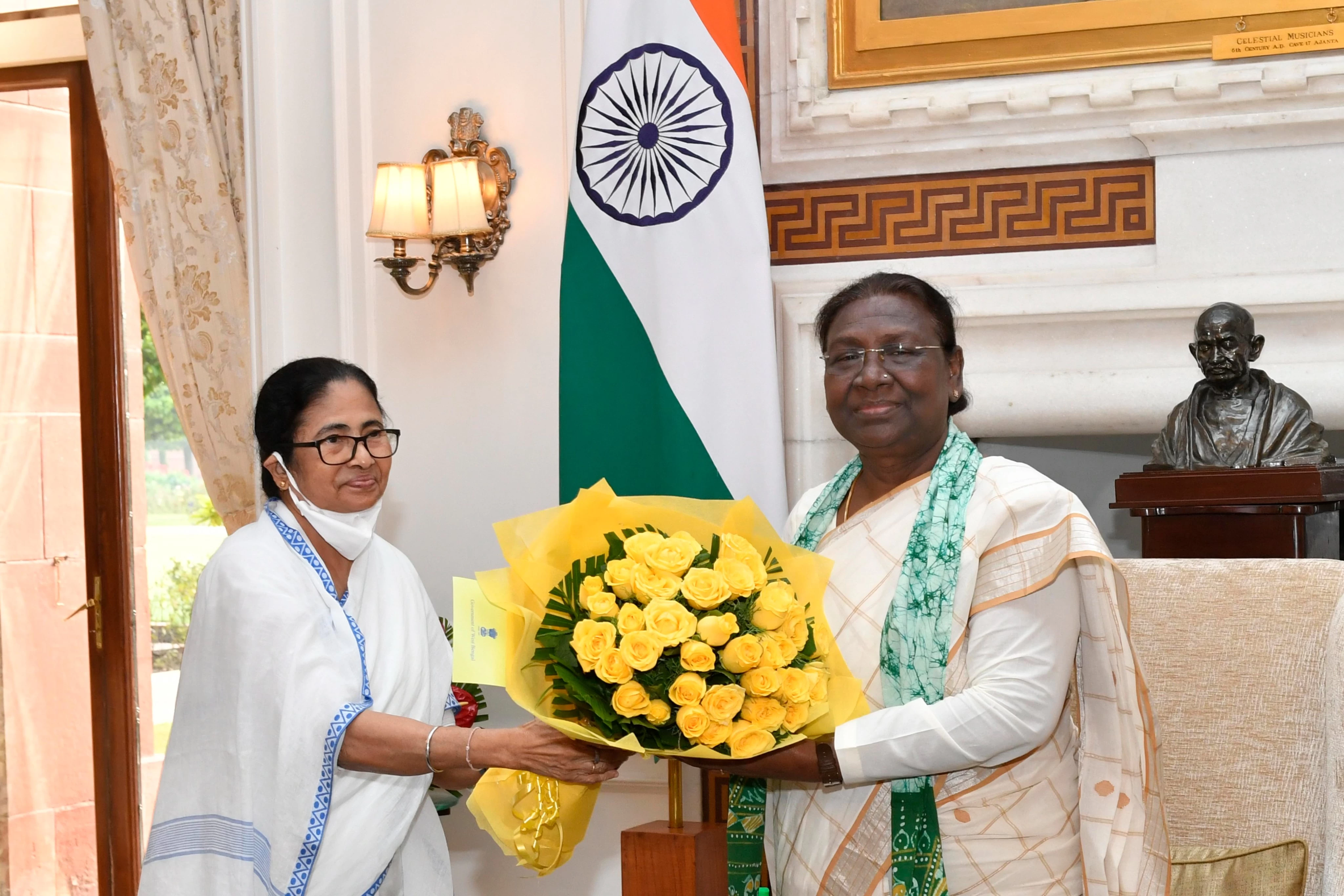
A routine presidential visit to North Bengal took an unexpectedly political turn on Saturday, setting off a sharp exchange between President Droupadi Murmu and West Bengal Chief Minister Mamata Banerjee.
The controversy began during Murmu’s visit to attend the Siliguri International Santal Conference. The event was originally scheduled to be held in Bidhannagar in Siliguri, but was later shifted to Gosainpur near Bagdogra Airport after the state administration cited security concerns. The programme eventually took place at the Airport Authority ground near Bagdogra, where turnout was reportedly modest.
However, the day’s politics truly began after the formal event ended.
On her way back, the President made an unscheduled stop at Bidhannagar — the venue where the conference had originally been planned but where permission had not been granted. Addressing a gathering of Adivasi residents there, Murmu openly questioned the decision to shift the programme and expressed disappointment over the arrangements surrounding her visit.
“I have come to know that permission was not granted here even for a small place,” she said, noting that the venue could have accommodated a far larger gathering. “Several lakhs of people could have attended here. I wanted to come, but I don’t know why Mamata Banerjee is so angry with me.”
In a remark that quickly travelled across political circles, the President added that neither the Chief Minister nor any state minister had come to receive her during the visit. “I am also a daughter of Bengal. Mamata Banerjee is like my sister,” she said, while expressing displeasure over the circumstances surrounding the event.
Murmu briefly interacted with people at the Bidhannagar site before leaving the venue.
The response from the state government was swift — and characteristically direct.
Speaking from a protest stage in Kolkata, where she was holding a dharna, Chief Minister Mamata Banerjee said she respected the President but accused the BJP of using the office for political messaging in the state.
“We respect our President, but I feel ashamed to say that even our President has been sent to sell their politics,” Banerjee said. “I have great regard for her, but she is trapped by the BJP.”
Rejecting the allegation that the state government had obstructed participation in the event, Banerjee questioned why the administration should be held responsible for the logistics of a political or privately organised programme.
“She said we did not allow people to attend. Is this a state event? How are we responsible?” Banerjee asked. “If they keep coming fifty times a year, how will I make you my priority? I am busy ensuring the rights of my people and I am at a dharna.”
The Chief Minister also said the state government had no clarity about the organisers of the conference. “I have no idea whose programme it was, who funded it and who organised it,” she said.
Banerjee further turned the argument toward tribal welfare policies, defending her government’s record and accusing the BJP of selective concern.
“When tribals in Manipur were in trouble, why were you quiet? When tribals in Rajasthan, Maharashtra and Madhya Pradesh faced problems, there was silence. Why target Bengal?” she asked.
Listing initiatives undertaken by the state government, Banerjee said her administration had ensured welfare programmes for tribal communities, including recognition of the Olchiki language, ration schemes for Jangalmahal residents, and financial support for Scheduled Tribe students.
“Previously Jangalmahal only saw bloodshed. Now there is peace, and the BJP is jealous of that,” she said.
Banerjee also suggested that the President had spoken only about one community during the event while ignoring others. She said leaders from her party would seek an appointment with Murmu to submit a detailed list of the state government’s work for minority and tribal communities.
By evening, what began as a cultural conference had turned into one of Bengal politics’ most unexpected showdowns — a moment where protocol met politics, and a presidential visit briefly became the state’s loudest political debate of the day.