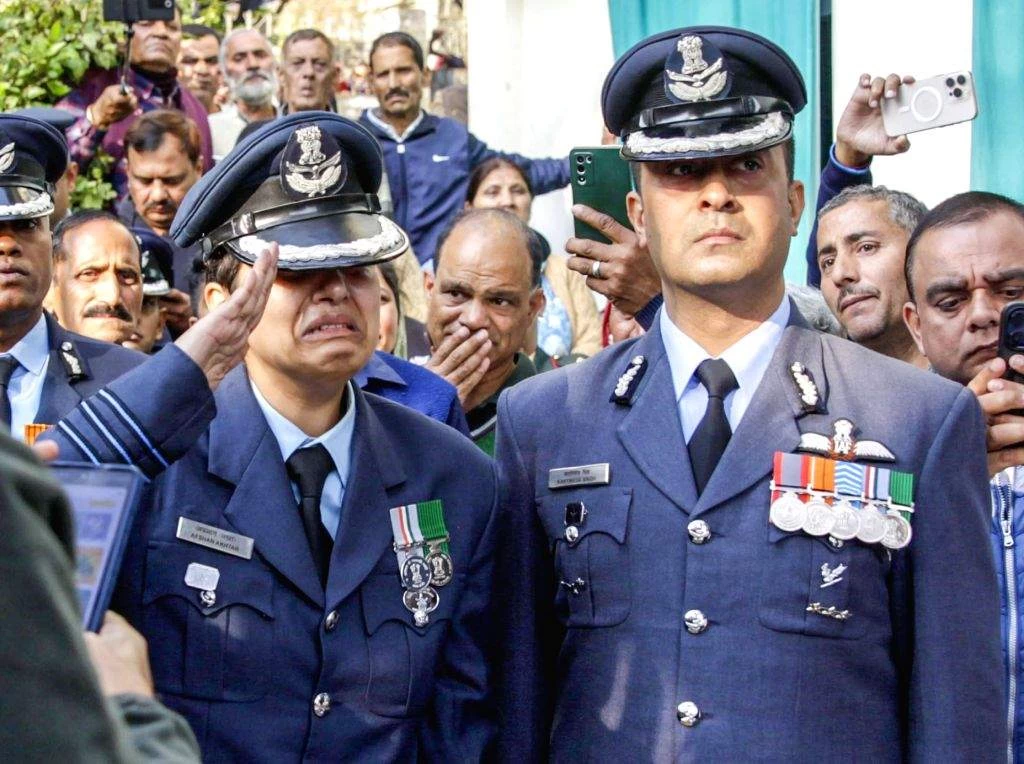
Under a heavy November sky, the quiet village of Patiyalkar in Himachal Pradesh's Kangra district fell silent as hundreds paid final respects to Wing Commander Namansh Syal, the Indian Air Force pilot whose daring display at the Dubai Air Show ended in unimaginable loss. The 34-year-old officer, a native son of this hillside hamlet, was cremated on Sunday afternoon with full military honours, his tricolour-draped casket borne through lanes lined with saluting villagers and uniformed comrades.
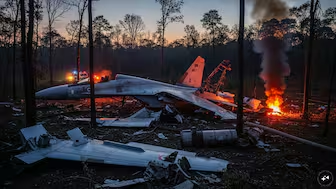
Syal's fatal crash occurred just two days earlier, on November 21, during the biennial Dubai Air Show at Al Maktoum International Airport. Piloting an indigenous Light Combat Aircraft (LCA) Tejas Mk-1 from No. 45 Squadron at Sulur Air Base, the veteran aviator executed a high-risk low-altitude aerobatic routine. Eyewitness accounts and footage described the sleek jet, struggling to recover from a negative-G manoeuvre before plummeting nose-first into the tarmac, erupting in a fireball of thick black smoke around 2:10 p.m. local time. The incident unfolded before an international audience of arms buyers and dignitaries, casting a shadow over the event's showcase of global aerospace innovation.
The Indian Air Force confirmed Syal's death swiftly, stating the pilot "sustained fatal injuries" and expressing profound regret. A court of inquiry, involving experts from Hindustan Aeronautics Limited (HAL) - the Tejas's manufacturer - has been ordered to probe the sequence, with early focus on the manoeuvre's aerodynamics rather than structural flaws. This marks the second Tejas mishap in under two years, though the first to claim a life, prompting renewed scrutiny of the platform's safety envelope in extreme displays. Defence Minister Rajnath Singh termed it a "deeply anguished" blow, lauding Syal's "bravery and courage," while Himachal Chief Minister Sukhvinder Singh Sukhu hailed him as a "valiant son of Kangra," announcing ex-gratia aid for the family.
Repatriated via an IAF C-130 from the UAE on Saturday, Syal's remains arrived at Sulur for a dignified wreath-laying before a final flight to Gaggal Airport in Kangra around noon Sunday. "We've lost our gem, the pride of our village," said a childhood friend of Syal, his voice breaking as he recalled Syal's sharp intellect and unyielding humility.
The ceremony's rawest moments centred on Syal's family. His wife, Wing Commander Afshan Akhtar, also an IAF officer stationed at Sulur, stood resolute in her service uniform, her arm protectively around their seven-year-old daughter. As Afshan rendered a salute, her composure cracking into quiet sobs that echoed the unspoken agony of a partnership forged in shared skies. Their daughter, wide-eyed and clutching a small garland, hesitated before placing flowers atop the glass panel, her tiny frame trembling against the weight of confusion and loss. The couple, who wed in 2017 after meeting in training, leave behind a legacy of dual devotion to duty.
Syal's father, retired Naib Subedar Jagan Nath - an Army Medical Corps veteran turned teacher - watched stoically as his elder son lit the pyre amid a three-volley gun salute and the haunting strains of the Last Post. Chants of "Namansh Syal amar rahe" rose from the crowd, mingling with "Jai Hind" as wreaths from the Chief of Air Staff and South Western Air Command were laid. Villagers, many of whom had seen Syal just months prior during a home visit, shared stories of his grounded roots: a boy from these rugged terrains who soared to over 1,500 flying hours, training the next generation of pilots and mesmerising crowds at Aero India.
With 16 years of service since his 2009 commissioning from the National Defence Academy, Syal embodied the Tejas's promise - a lightweight, multi-role marvel designed for agility in contested airspace.