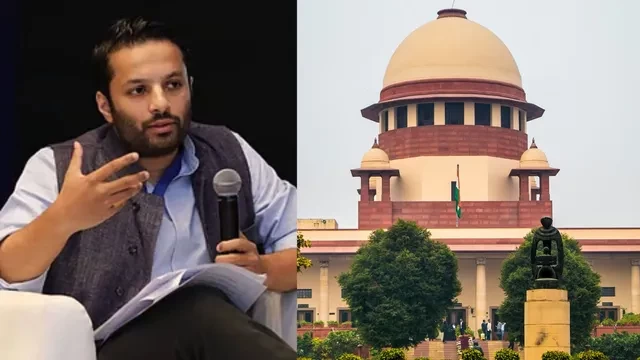
In a big relief to Ashoka University Professor Ali Khan Mahmudabad, the Supreme Court of India on Monday has temporarily suspended legal proceedings against him in connection with his controversial social media posts about Operation Sindoor. The bench of Justices Surya Kant and Joymalya Bagchi criticised the Haryana Police’s Special Investigation Team (SIT) for overstepping its mandate during the investigation.
Taking note of this development, the bench of Justices Surya Kant and Joymalya Bagchi quashed the FIR in which the closure report was filed; as regards the other FIR, the Court passed an interim order barring the Magistrate from taking cognizance of it. Additional Solicitor General of India SV Raju appeared for the Haryana Police.
Senior Advocate Kapil Sibal, for the petitioner, told the bench that it was "most unfortunate" that the police invoked Section 152 of the Bharatiya Nyaya Sanhita, which deals with offences attacking the sovereignty of the nation, for the social media comments. Sibal added that the Supreme Court is now examining the constitutionality of Section 152 BNS.
Professor Ali Khan Mahmudabad was arrested on May 18, 2025, following two First Information Reports (FIRs) filed by the Rai police in Sonipat, Haryana. The FIRs, based on complaints from the Haryana State Commission for Women chairperson and a village sarpanch, accused Mahmudabad of making social media posts that allegedly endangered India’s sovereignty and promoted communal disharmony. The posts, made on May 8 and May 11, 2025, were perceived as critical of India’s military operation, Operation Sindoor, and disrespectful toward women officers involved in its media briefings.
The Supreme Court granted interim bail to Mahmudabad on May 21, 2025, but allowed the investigation to continue under a three-member SIT, which was instructed to focus solely on the content of the two posts. However, concerns arose when the SIT expanded its probe, seizing the professor’s electronic devices and inquiring into unrelated matters, such as his travel history.
During the July 16 hearing, the bench expressed frustration with the SIT’s approach, with Justice Kant remarking, “You don’t need him, you need a dictionary!” The court questioned the necessity of seizing Mahmudabad’s devices and emphasised that the investigation should be confined to determining whether the posts constituted an offence under the law. The SIT was given four weeks to complete its probe and submit a report, with the court clarifying that Mahmudabad, who has cooperated fully, should not be summoned again unless absolutely necessary.
The court also relaxed earlier bail conditions that restricted Mahmudabad’s freedom of expression. While he remains barred from commenting on the ongoing case or Operation Sindoor, he is now permitted to write articles, post online, and express opinions on other matters. This decision aims to balance the professor’s right to free speech with the need to avoid interference in the subjudice case.
The Supreme Court’s intervention has sparked discussions about the boundaries of free speech, particularly in sensitive contexts involving national security. Several political parties and academics had previously condemned Mahmudabad’s arrest, arguing it was an overreach by the authorities. Ashoka University issued a statement expressing relief at the court’s decision to grant interim bail and ease restrictions, noting that it provided comfort to the professor’s family and the university community.