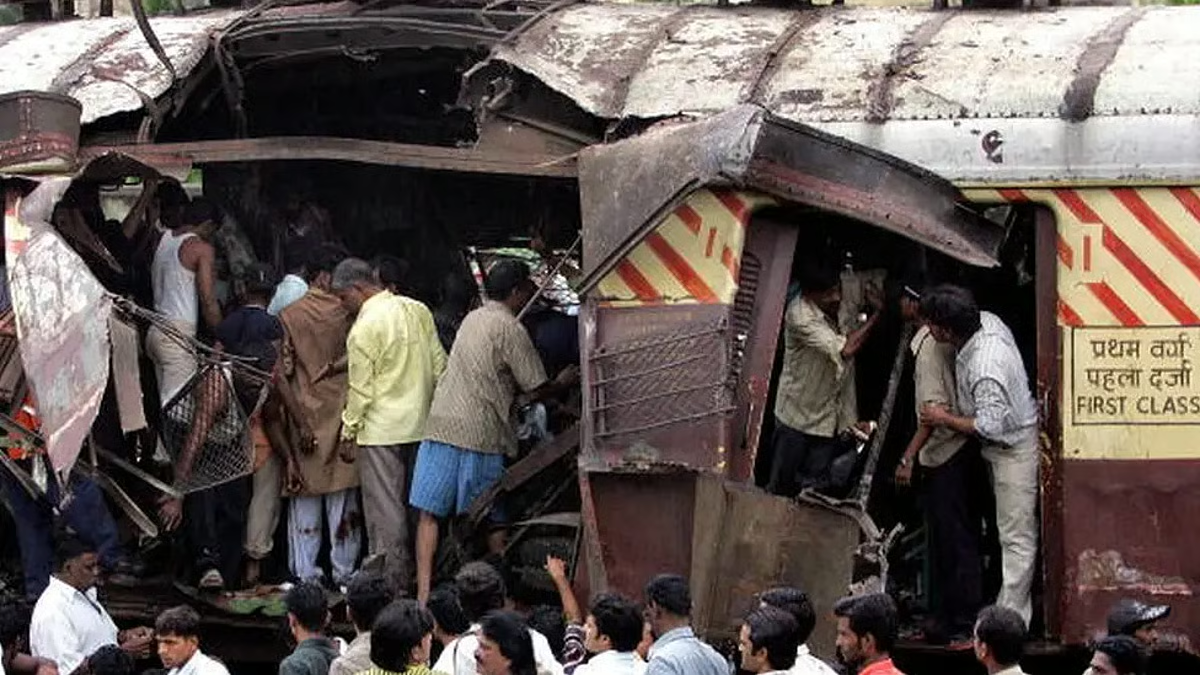
The Maharashtra government, in its special leave petition (SLP) before the Supreme Court, has strongly contested the Bombay High Court’s acquittal of all 12 men convicted by a special trial court in the 2006 Mumbai train blasts case.
The state has argued that the High Court "utterly failed to even discuss how the conviction under the Unlawful Activities (Prevention) Act (UAPA) is not sustainable." Despite not overturning the trial court’s reasoning for convicting the accused under special laws, the High Court went on to acquit them under UAPA, the petition noted.
Defending the invocation of the Maharashtra Control of Organised Crime Act (MCOCA), the state government stated that prior approval for prosecution under the Act was properly obtained. It clarified that MCOCA itself, unlike the procedural rules, does not prescribe any specific format for granting such sanction.
“What is required to be seen,” the petition said, “is whether the accused were continuously indulging in activities prohibited by law, which are cognizable offences punishable with imprisonment of three years or more, and whether at least one chargesheet had been filed and taken cognizance of by a special court in the preceding ten years.”
The state said one of the accused, Zameer Shaikh, challenged the constitutional validity of MCOCA before SC. The SLP stated SC held that the unlawful activities under MCOCA were "altogether different from the meaning of the term unlawful activities under UAPA." The state mentioned SC in 2010 maintained Shaikh's prosecution under both special Acts, MCOCA and UAPA.
The Maharashtra government, in its special leave petition (SLP), has criticised the Bombay High Court for rejecting the recovery of 500 grams of RDX on what it termed a “hyper-technical” ground, the absence of a 'lac seal'. The state argued that the RDX was not sealed due to its inflammable nature and pointed out that the prosecution had produced the sanctioning authority under the Explosive Substances Act as a witness. Notably, the High Court itself found no infirmities in this witness’s testimony, the petition added.
The Maharashtra government also took strong exception to the High Court's dismissal of confessional statements made by the accused, particularly that of accused number 5. In its special leave petition, the state termed the High Court’s reasoning as “unacceptable” and “very strange,” pointing out that the confession was rejected merely because it lacked specific details such as the date of arrival from Pakistan, physical descriptions, training background, and addresses of six alleged Pakistani nationals.
The state further criticised the High Court’s decision to discard the recovery of explosive granules and a detonator from one of the accused’s residences, again citing the absence of a 'lac seal' as an overly technical ground for rejection.