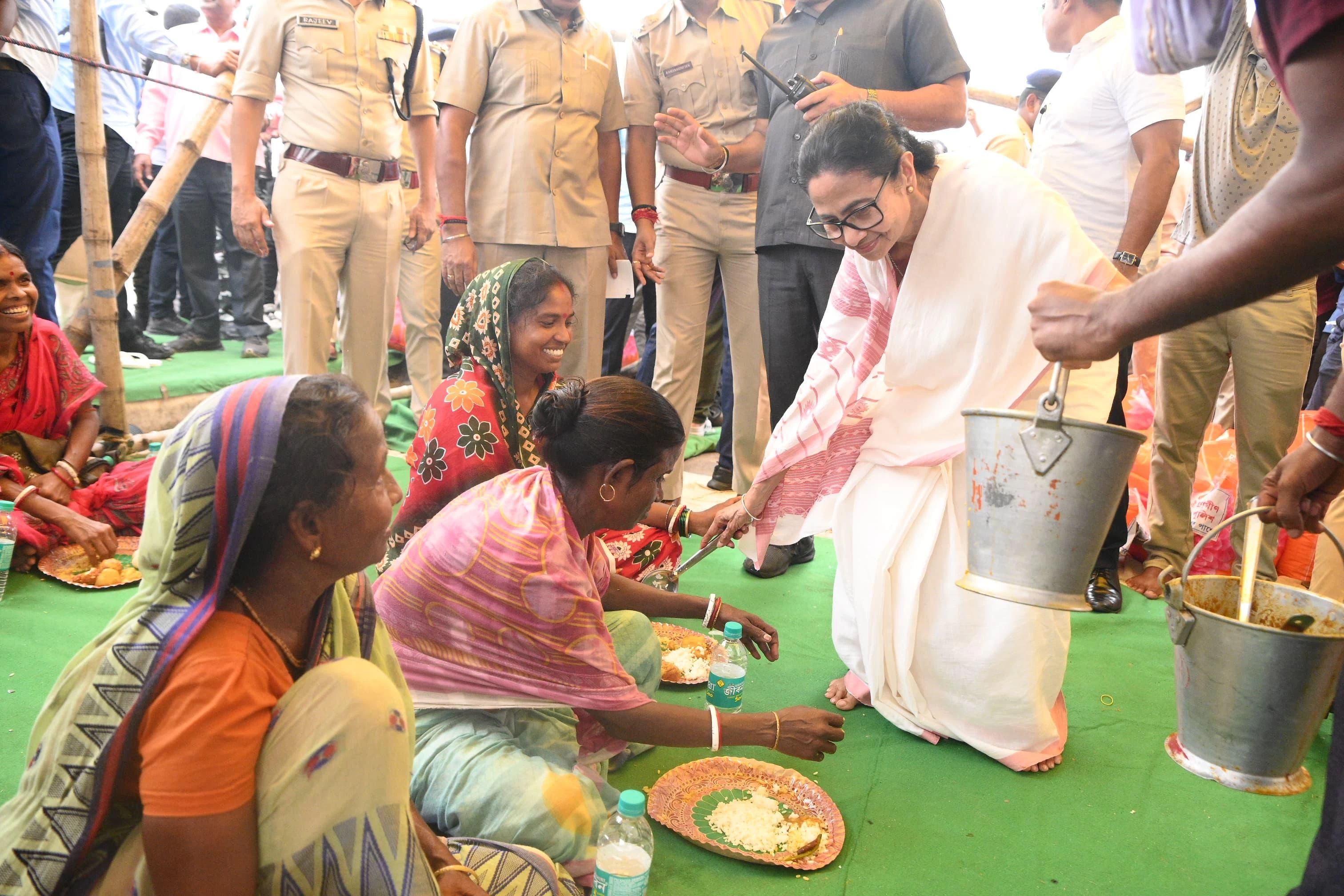
West Bengal Chief Minister Mamata Banerjee, on Tuesday has reacted sharply on BJP’s brazen defence of Delhi Police terming Bengali as ‘Bangladeshi language’, called it a blatant insult to the legacy of a language that has given India its national Anthem. While visiting flood-affected areas in Ghatal, West Midnapore, she launched a scathing attack on the Bharatiya Janata Party (BJP), also over the ongoing controversy surrounding recently launched voter revision drive by Election Commission of India (ECI) in Bihar, which she called a “planted game” to disenfranchise legitimate voters for vested political interests. Amidst strong speculations that Special Intensive Revision (SIR) may also be implanted in poll bound West Bengal where assembly elections are due early next year, Mamata Banerjee urged everyone to take the voter updation drive very seriously and ensure to get their names enlisted. She also expressed alarm and equated SIR with a covert operation to implement the National Register of Citizens.
"In the name of SIR, they are planning to do NRC. Everyone should take the drive to update your name on the voter card list very seriously. Don’t take it for granted. It’s a garb to strike off the names of the people," she urged, assuring support for those whose names might be removed. "If they strike your name out, then challenge it. We will support you all in every way possible. This is a ploy to send legitimate Indians to Bangladesh. This is a planted game of the double engine government along with the Election Commission."
She questioned the intentions of the BJP led central government in invalidating identity documents like Aadhaar, voter ID, and ration cards as proof of citizenship, which the ECI too has deemed insufficient for proving citizenship in the voter revision process. "The ECI did the voter cards, and now they want to scrap them. The central government spent crores of money to get everyone Aadhaar cards, and now they don’t want to consider that as proof of citizenship. Then why did they waste the money?" Banerjee asked, highlighting the financial and logistical burden imposed on citizens. She raised concerns about the stringent documentation requirements, particularly the demand for birth certificates of parents, which she argued is impractical for many. "How will people who were born some 50 or 60 years ago have birth certificates?" she questioned, alleging that the process is designed to discriminate against vulnerable groups. She pointed to the NRC exercise in Assam, where "over 7 lakh Hindus were disenfranchised, along with women, Muslims, and Scheduled Caste people," as evidence of a broader agenda to marginalise certain communities.
Evoking the Bengali pride sentiment, she refused to answer questions asked by journalists in Hindi and asserted that “if they hate Bengali then I better answer in Bengali”. Addressing the Delhi Police letter that sought a translator from Banga Bhawan to interpret documents written in the "Bangladeshi language," Banerjee called it a deliberate affront to Bengali identity. "Now they are saying there is no existence of the Bengali language, imagine their audacity. The language that gave us our national anthem, BJP wants to dismiss it," she said, emphasising the cultural and constitutional significance of Bengali, the language of luminaries like Rabindranath Tagore and Swami Vivekananda. She further challenged BJP leader Amit Malviya, who had called for her to be booked under the National Security Act (NSA) for allegedly inciting linguistic conflict. "Let them come and arrest me if they can, I don’t care. I will speak in Bengali, and that’s my mother tongue," Banerjee declared defiantly.
The Chief Minister also condemned a recent NRC notice served to a Rajbanshi resident in Coochbehar by the Assam government, marking it as the third such instance. She questioned the Assam government's authority to issue such notices in West Bengal, calling it an overreach and a "systemic assault on democracy." This incident has further fuelled the TMC-BJP conflict, with Banerjee accusing the BJP of targeting Bengali-speaking communities to erode their cultural identity.
The controversy, sparked by the Delhi Police letter and intensified by the voter revision drive, has become a major flashpoint in Indian politics, with Banerjee positioning herself as a defender of Bengali pride and democratic rights.