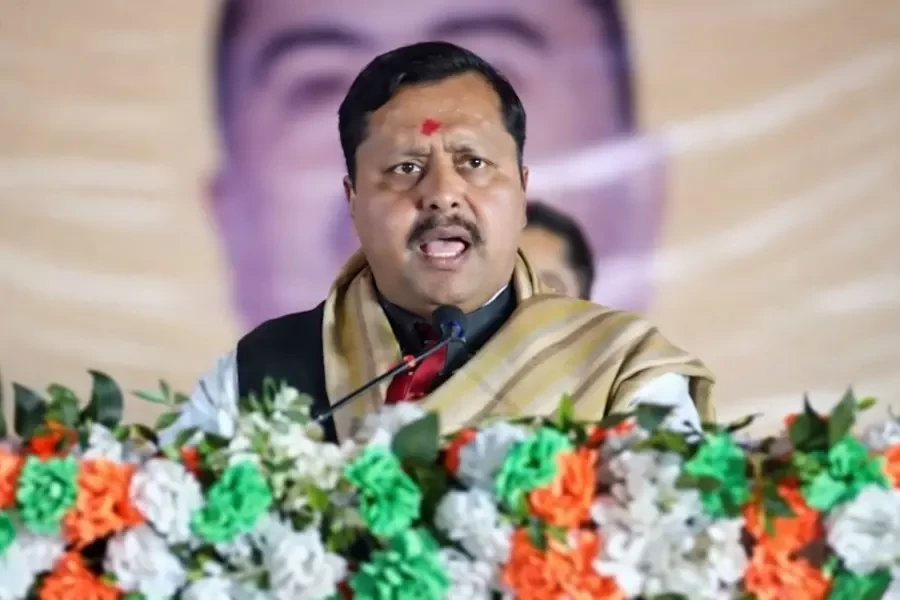
A fresh controversy has erupted in West Bengal’s charged political atmosphere after BJP president Nitin Nabin referred to Rabindranath Tagore as a “Nobel Peace Prize winner” during a public programme in Durgapur on Wednesday. The remark, widely seen as a factual error, has handed the Trinamool Congress (TMC) yet another opportunity to question the Bharatiya Janata Party’s cultural connect with Bengal ahead of the upcoming Assembly elections.
Addressing a karyakarta sammelan at Rajiv Gandhi Maidan as part of the BJP's outreach ahead of the upcoming state assembly elections, Nabin paid tribute to several Bengali icons, including Ramakrishna Paramhansa and Tagore. He highlighted Tagore's contributions to education, stating that the poet-philosopher had introduced a novel approach to learning not just in Bengal but across India. "For that, he was honoured with the Nobel Peace Prize," Nabin said, while expressing his homage to the "Kaviguru."
Rabindranath Tagore, Bengal’s most revered cultural icon, was awarded the Nobel Prize in Literature in 1913, becoming Asia’s first Nobel laureate. Nitin Nabin’s reference to Tagore as a Nobel Peace Prize recipient immediately drew criticism from opposition leaders, academics and social media users, who called it a “basic historical blunder” unbecoming of the national president of a major political party.
The TMC was quick to seize upon the remark, accusing the BJP of repeatedly displaying ignorance about Bengal’s history, culture and icons while attempting to expand its political footprint in the state. Senior TMC leaders said such mistakes reinforce the perception that the BJP’s engagement with Bengal is “electoral, not cultural”.
Nitin Nabin’s comment is the latest in a series of high-profile slips by BJP leaders involving Bengal’s cultural figures and symbols. In the past, Union Home Minister Amit Shah, in 2021 had stated at a public event that Rabindranath Tagore was born in Shantiniketan, a claim that is historically incorrect. Tagore was born in Jorasanko, Kolkata, while Shantiniketan later became the centre of his educational and cultural vision.
Prime Minister Narendra Modi too had drawn criticism when he referred to Bankim Chandra Chattopadhyay as “Bankim da” during his speech on ‘150 years of Vande Mataram’ on the floor of Lok Sabha - a form of casual reference that many in Bengal felt diluted the stature of the author of Vande Mataram. Around the same time, Union minister Anurag Thakur had mistakenly referred to Vande Mataram as “Vande Bharat” again on the floor of parliament last year, prompting ridicule and outrage.
Political analysts say these repeated missteps have allowed the TMC to strengthen its narrative that the BJP lacks a genuine understanding of Bengal’s intellectual and cultural legacy. During the 2021 Assembly elections, Mamata Banerjee’s party aggressively projected the idea of “Banglar Gorbo” (Bengal Pride), framing the contest as one between local identity and what it described as cultural imposition from outside the state.
That narrative, analysts argue, struck a chord with voters, contributing to the BJP’s failure to dislodge the TMC despite an aggressive campaign and the deployment of central leaders. The recurrence of similar bloopers ahead of another election cycle is now being viewed as politically damaging for the BJP.
TMC leaders have said that such remarks are not isolated mistakes but reflect a deeper disconnect. “You cannot claim Bengal while getting its icons wrong,” said Kunal Ghosh, TMC spokesperson said, adding that reverence for figures like Tagore and Bankim Chandra Chattopadhyay is “non-negotiable” in the state’s political psyche.
While the BJP has not yet issued a formal clarification on Nitin Nabin’s remark, party insiders admit that cultural sensitivity remains a challenge in Bengal. With elections drawing closer, parties are expected to amplify these slips to reinforce the narrative of cultural alienation.