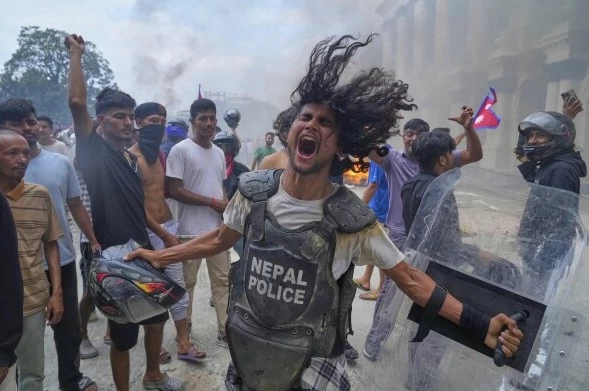
Nepal is reeling from one of the most violent political unrest in its recent history, as youth-led protests triggered a social media ban exploded into widespread rioting, arson, and direct assaults on political leaders. The carnage peaked when protestors and set fire to the country’s Supreme Court and Parliament building just minutes after Prime Minister KP Sharma Oli officially resigned from office following days of escalating violence.
The private residence of PM Oli in Balkot, Bhaktapur, was also torched by protesters, who accused his government of ordering a brutal police crackdown on Monday that killed at least 19 civilians and injured over 300. The violence prompted the Nepal Army to step in and impose a nationwide curfew.
Rajyalaxmi Chitrakar, wife of former Prime Minister Jhala Nath Khanal, died from severe burn injuries after their house in Dallu was set on fire. Eyewitnesses reported she was trapped inside as the blaze took hold. Despite efforts to save her, she succumbed to her injuries at a local hospital.
Videos now viral on social media show former Prime Minister Sher Bahadur Deuba, head of the ruling Nepali Congress party, and his wife, Foreign Minister Dr Arzu Rana Deuba, being physically attacked at their Kathmandu residence. Both were seen bleeding, visibly shaken, and were assisted to safety by party members.
Residences of current or former leaders were attacked or torched, including those of President Ram Chandra Paudel, former PM Pushpa Kamal Dahal, Communications Minister Prithvi Subba Gurung, Deputy PM Bishnu Paudel, former Home Minister Ramesh Lekhak, and Nepal Rastra Bank Governor Biswo Paudel. Government offices and banks were also ransacked.
Protesters showed no signs of backing down, even as curfews were imposed in Kathmandu, Lalitpur, Makwanpur, Koshi Province, Birgunj, and Kavrepalanchok. Armed forces and riot police clashed with demonstrators on multiple fronts, using tear gas to disperse stone-throwing mobs.
Despite the government lifting its ban on social media platforms like Facebook, YouTube, X, and TikTok late Monday night, public fury only deepened. The protests, initially triggered by a law requiring social media companies to register with the government, have since evolved into a broader anti-establishment movement, targeting political corruption, nepotism, and lack of opportunity.
President Ram Chandra Paudel has called for dialogue and restraint, expressing sorrow over the lives lost and property destroyed. “I urge all sides to remain calm, prevent further harm to the nation, and come to the table for talks,” he said in a televised address. “In a democracy, the demands raised by citizens can be addressed through dialogue and negotiations.”
The Nepal Army, now in operational control of internal security, issued a stern warning, “Some groups are taking undue advantage of the difficult situation and causing severe damage to ordinary citizens and public property.”
India, Nepal’s largest neighbour, expressed deep concern and issued a travel advisory urging its citizens to defer non-essential travel to Nepal. “As a close friend and neighbour, we hope that all concerned will exercise restraint and address any issues through peaceful means and dialogue,” India’s Ministry of External Affairs said in a statement.
Nine Western nations, including the United States, United Kingdom, France, Germany, Japan, Australia, South Korea, Norway and Finland, issued a joint appeal for calm, urging Nepal to safeguard democratic rights and avoid further escalation.