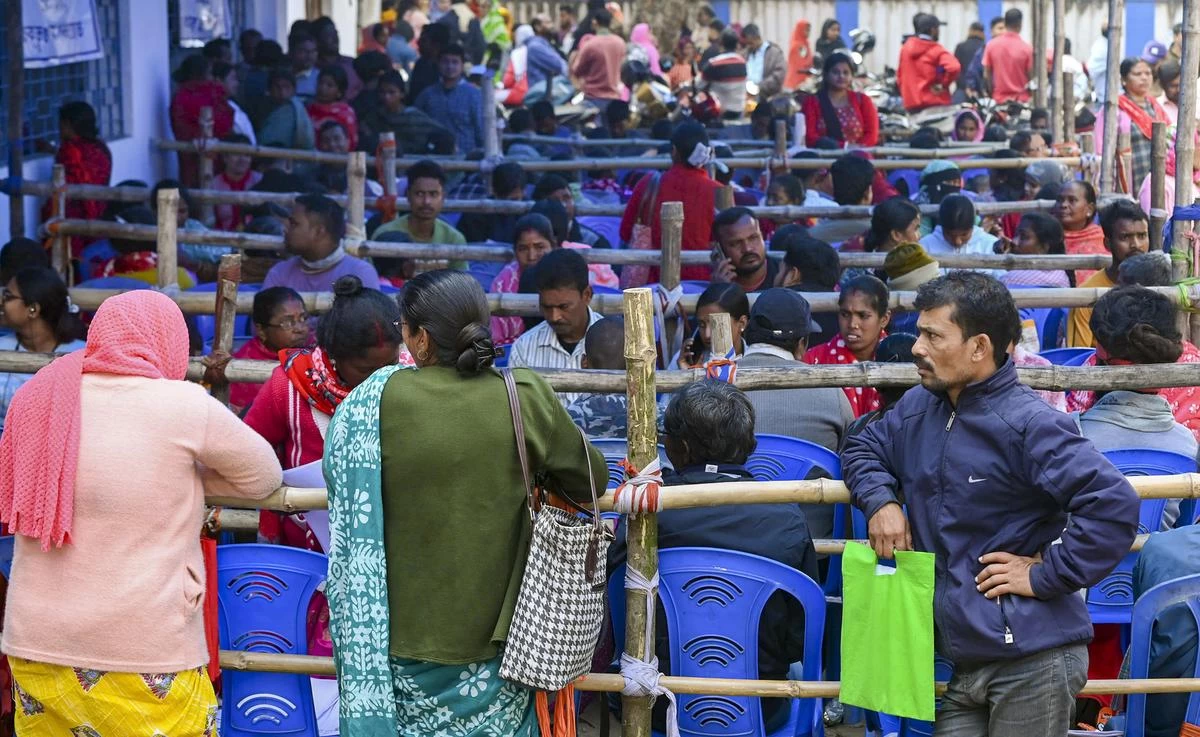
A significant proportion of voters flagged for “logical discrepancies” during the electoral roll revision in two key south Kolkata constituencies belong to the Muslim community, prompting fresh debate over whether the system-driven scrutiny process is disproportionately affecting certain groups. The pattern has emerged from a recent analysis of the Election Commission’s special intensive revision (SIR) exercise.
The study, conducted by the Sabar Institute, focuses on Bhowanipore and Ballygunge — two politically significant assembly constituencies in south Kolkata. It found that Muslim voters account for approximately 52% of those marked under the “logical discrepancy” category in Bhowanipore and nearly 78% in Ballygunge.
In Bhowanipore, 7,846 out of 15,145 voters whose enumeration forms were flagged for “logical discrepancies” are Muslims, according to the study. In Ballygunge, the figure is considerably higher, with 23,256 of the 30,008 voters in the same category belonging to the minority community. Researchers have noted that this skew stands out when compared with other categories of voter verification.
“In Bhowanipore, Muslims form only 22.7% of voters marked as ‘absent, shifted or dead/duplicate’ (ASD) and about 26% of unmapped voters,” said Ashin Chakraborty, who conducted the study along with Souptik Halder and Sabir Ahamed. “Those figures broadly match the Muslim population share of around 20% in the constituency, as per the 2011 Census.”
A comparable trend is visible in Ballygunge, where Muslims constitute about 44% of ASD voters and around 42% of unmapped voters — figures that align more closely with their estimated population share of nearly 50% in the constituency. The disparity within the “logical discrepancy” category, researchers argue, calls for closer examination of the parameters used in the software-driven screening process.
Election Commission officials have rejected suggestions of bias, maintaining that the electoral roll does not record religious identity and that no religion-wise voter database is maintained. An official emphasised that the revision exercise is based solely on procedural checks and technical criteria.
The findings have drawn strong political responses. Political analyst Udayan Bandyopadhyay alleged that the artificial intelligence programme used in the SIR exercise may have been “intentionally designed” in a manner that disproportionately affects minority voters, particularly women. Trinamool Congress spokesperson Kunal Ghosh accused the Bharatiya Janata Party of using electoral roll revisions to target Muslim-majority areas.
The data has added another layer of controversy to the ongoing SIR exercise in Kolkata, with growing calls for an independent audit of the “logical discrepancy” filter to ensure that the revision process remains transparent and does not disproportionately impact any community.