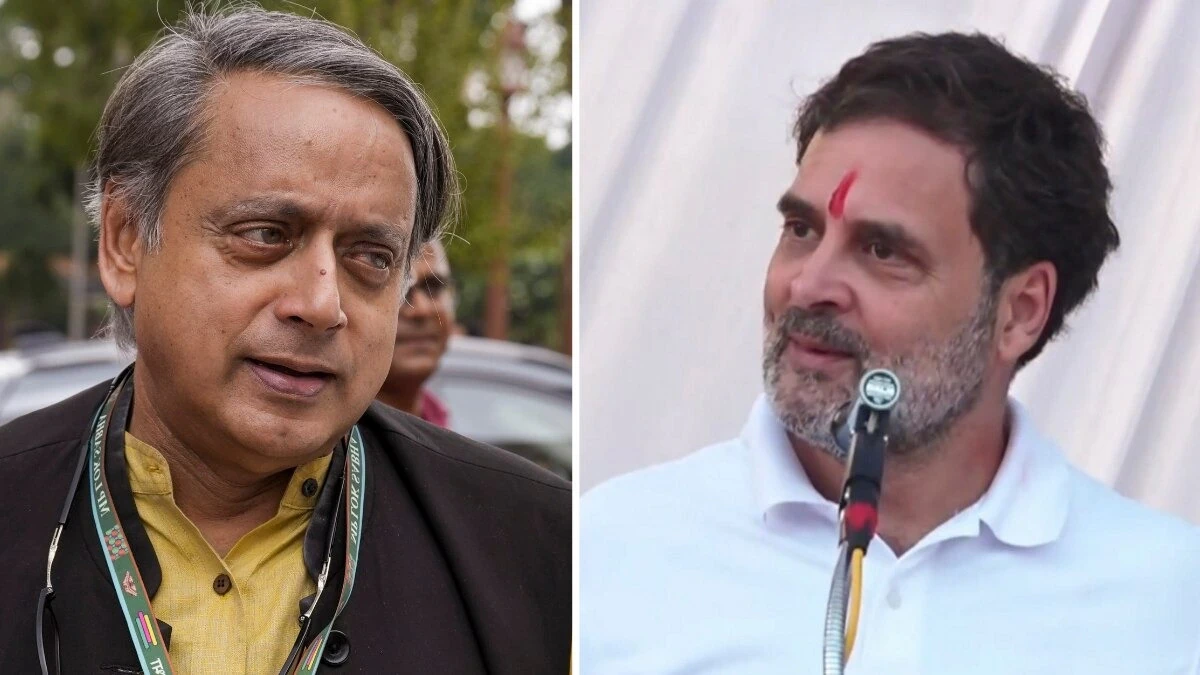
A detailed social media exchange on Sunday evening sparked fresh debate over the ideological direction of the Congress, after an X user dissected what he described as a growing rift between the Rahul Gandhi-led party and senior leader Shashi Tharoor.
In a thread of nearly a dozen posts, the user, who goes by the name Civitas Sameer, characterised the friction as an “ideological showdown” and framed it as a clash between two competing strands within the Congress. He argued that the party has failed to “choose, integrate, or execute either, coherently”.
Tharoor, the Thiruvananthapuram MP, briefly acknowledged the analysis, responding on X, “Thank you for this thoughtful analysis. There has always been more than one tendency in the party; your framing is fair, and reflective of a certain perception of the current reality.”
The response drew an immediate and surprised reply from the user, who wrote simply, “Damn!”
At the heart of the argument was the Congress’s strategic shift after 2010, which the post described as a move towards a “rural grievance-driven mass party” in an effort to counter the electorally dominant Bharatiya Janata Party. This, the user said, stood in contrast to Tharoor’s political positioning, which he linked to a more urban, institution-focused Congress of the 1990s.
“This orientation emerged during economic transition and elite-led governance, not as virtue, but as a historical circumstance,” the post said, adding that leaders such as PV Narasimha Rao, Manmohan Singh as finance minister, SM Krishna and Montek Singh Ahluwalia operated within this framework. “Their politics relied on policy, institutions, and administrative competence, not mass mobilisation or cultural embedding.”
The user went on to accuse the Congress of repeatedly marginalising such leaders. “It is these very same urban technocratic leaders that the Congress sidelines, again and again,” he wrote, claiming they often receive “more recognition and respect from the RW (right wing) than the party” itself.
Several observers saw the commentary as an indirect reference to former Congress figures such as Jyotiraditya Scindia, who defected to the BJP in 2020, triggering the collapse of the Congress government in Madhya Pradesh. Since switching sides, Scindia has served as Union aviation minister and, in the current Modi government, as Union communications minister.
Others, including former Rajasthan deputy chief minister Sachin Pilot, have also been cited by critics as part of a younger, reform-minded generation that has been sidelined by the party’s old guard.
Drawing a contrast between these leaders and the Congress’s post-2010 strategy, the user argued that the shift towards rural politics lacked credibility. “The most ironic part of it all is that the individual leading this rural turn (i.e., Rahul Gandhi) is among the most elite and insulated figures in Indian politics,” he wrote. “Born into a dynastic family, symbolic rural politics without lived or organisational depth lacks any credibility.”
He further argued that rural politics in India requires sustained organisational work. “Rural politics in India is not rhetorical. It is organisational, cultural, and long-term,” the post said. “BJP succeeds here because of cadre depth, discipline, and cultural alignment through the RSS. Congress has none of this infrastructure, and yet wants to behave like a poor man’s messiah.”
Summing up his critique, the user said the party had lost its political moorings. “The Congress today is neither a credible urban reformist party nor a serious rural mass party. It has abandoned one without successfully transforming,” he wrote, adding that its identity had become “primarily oppositional and not aspirational”. “For a national party, this is fatal.”
The analysis also dismissed claims by some Congress leaders that Tharoor has drifted rightwards following recent remarks praising Prime Minister Narendra Modi. According to the posts, the four-time Lok Sabha MP remains “a proud Hindu from day one for his own reasons”. “Like the urban technocratic leaders of the past,” the user concluded, “he is being sidelined by this new Congress.”