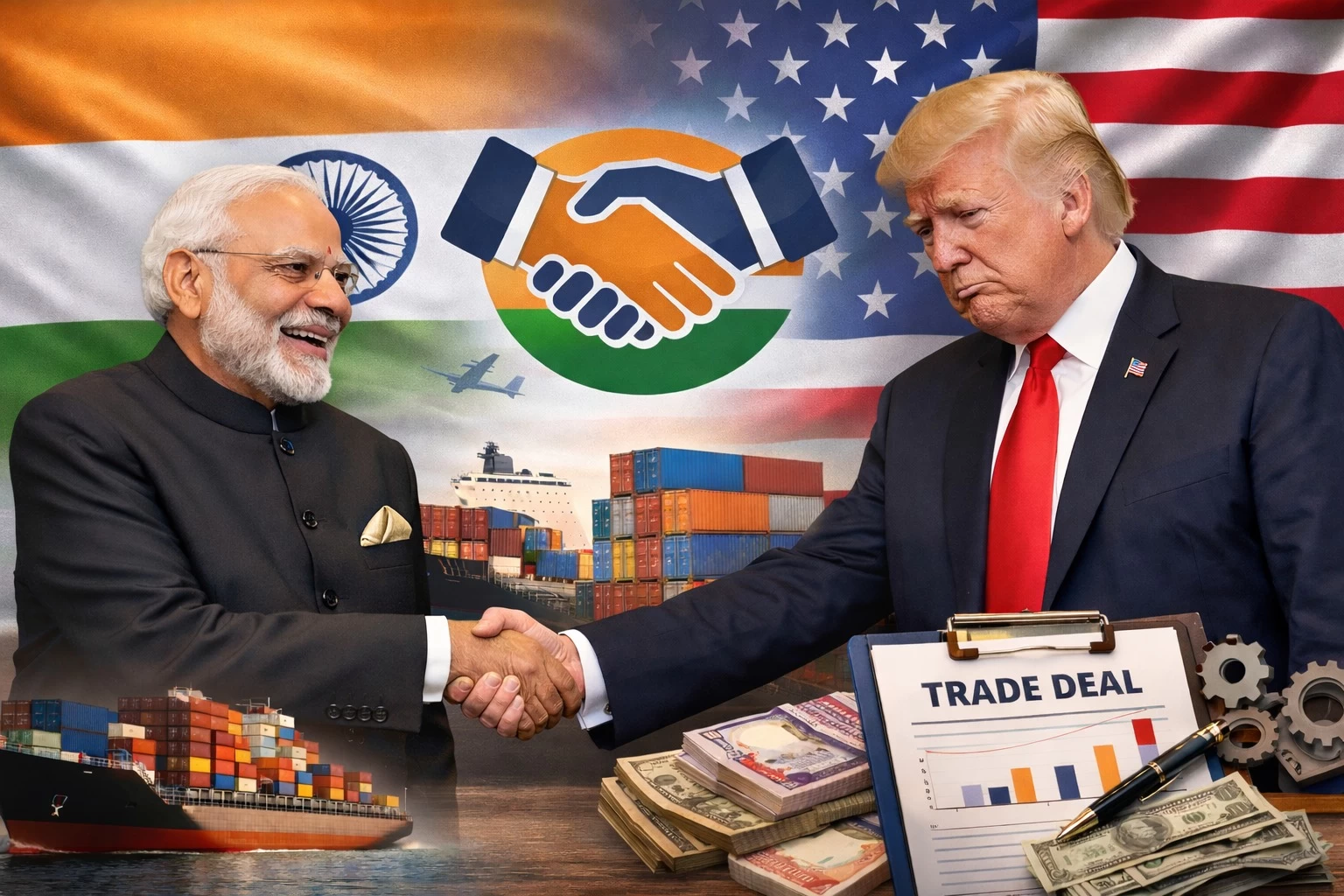
The evolving US–India trade agreement is still being fine-tuned, with both sides quietly reshaping key provisions before the final signing expected around mid-March. While the deal was announced by President Donald Trump nearly 10 days ago, fresh revisions to the White House fact sheet suggest that negotiations remain active behind the scenes. The changes—many of which align more closely with India’s stated positions—indicate that irritants are being smoothed out and that New Delhi may be securing additional concessions before the agreement is formally sealed.
It ain’t over until it’s over appears to be the guiding principle for the current round of negotiations. The Trump administration has discreetly updated its official fact sheet after discrepancies emerged between its original language and the US-India joint statement. These differences—particularly regarding pulses and a $500 billion purchase “commitment”—sparked confusion and criticism from opposition voices. With the updated version now removing or softening contentious terms, the White House appears to be addressing concerns and signalling that backchannel discussions with India are ongoing.
The original fact sheet was released earlier in the week but was revised within 24 hours. Media reports suggested that certain terms and wordings not agreed upon by both countries were rolled back following feedback from the Narendra Modi government. The swift revision is being interpreted as a sign that Washington is willing to adjust language and expectations to keep negotiations on track and avoid friction ahead of the final signing.
One of the most significant revisions relates to tariffs on pulses—an issue that is highly sensitive for India’s agricultural sector. The initial fact sheet stated:
"India will eliminate or reduce tariffs on all US industrial goods and a wide range of food and agricultural products, including dried distillers' grains (DDGs), red sorghum, tree nuts, fresh and processed fruit, certain pulses, soybean oil, wine and spirits, and additional products," it stated.
In the revised version, references to pulses have been removed entirely. This change is notable because agricultural imports—especially pulses—have long been a red line for India during trade negotiations. India is both the world’s largest producer and consumer of pulses, accounting for roughly 25–28% of global production, making any tariff concessions politically and economically sensitive.
The issue of pulse tariffs has been contentious for months. Two US senators had previously urged Trump to pressure India to eliminate a 30% import duty on US pulses, which took effect on November 1 and was widely viewed as a response to the 50% tariffs imposed by Washington last year. Under the evolving trade framework, that duty has now been reduced to 18%, suggesting a compromise that allows both sides to claim partial wins.
Another key change involves India’s proposed purchase of US goods and services. In the earlier version of the fact sheet, India was described as “committed” to purchasing $500 billion worth of American products over five years. The updated document replaces “committed” with “intend”—a subtle but economically significant shift that reduces the binding nature of the pledge.
"India committed to buy more American products and purchase over $500 billion of US energy, information and communication technology, agricultural, coal, and other products," the paragraph in the previous fact sheet said.
In the revised version, not only has “committed” been changed to “intend,” but references to “agricultural goods” have also been removed. These edits give India greater flexibility in meeting its purchase targets and reduce domestic pressure tied to mandatory agricultural imports.
A further adjustment concerns India’s digital services tax (DST). The earlier fact sheet suggested that India would “remove” its digital services taxes, which caused confusion because India’s official statement did not include any such commitment. In the updated version, the White House has removed that language entirely. Instead, it now states:
"India committed to negotiate a robust set of bilateral digital trade rules that address discriminatory or burdensome practices and other barriers to digital trade," it now states.
Taken together, these revisions suggest a deliberate effort by Washington to align its public documentation more closely with the jointly agreed framework and to avoid friction with New Delhi. With negotiations still active and sensitive provisions being reworked, the final shape of the US-India trade deal will likely reflect continued compromise on both sides before it is formally signed.