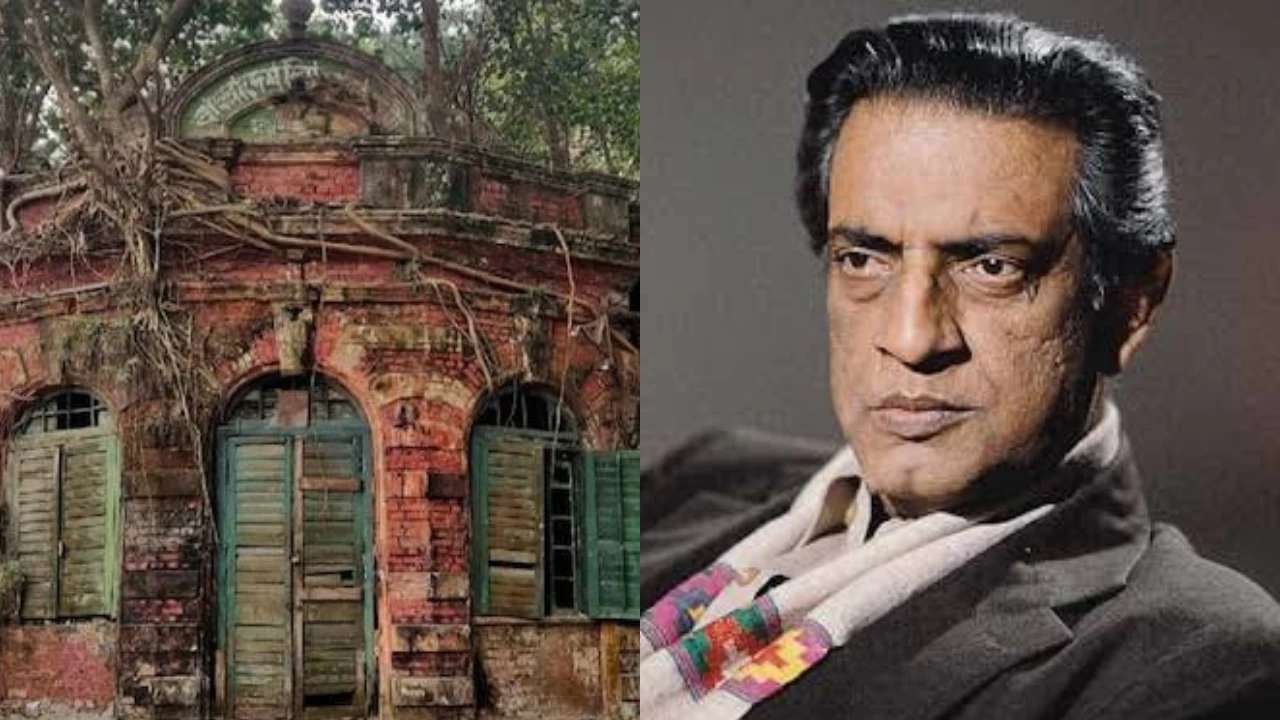
The ongoing demolition of filmmaker Satyajit Ray’s ancestral house in Mymensingh, Bangladesh, has been suspended, this comes after mounting pressure from India. Bangladeshi authorities have now formed a committee to explore the possibility of restoring the structure.
The intervention follows strong reactions from both the Indian government and West Bengal Chief Minister Mamata Banerjee, who condemned the demolition and called the house an essential part of Bengal’s cultural legacy.
The house in question is linked to Ray’s grandfather, Upendrakishore Ray Chowdhury, a prominent Bengali writer and publisher. Although there is debate over whether Upendrakishore ever resided in the Mymensingh property, its historical connection to the Ray family has stirred widespread concern.
Faisal Mahmud, Minister (Press) at the Bangladesh High Commission, clarified to NDTV that “Ray never lived in that house. In fact, his grandfather probably didn’t either. He lived in Kotiadi, in the neighbouring Kishoreganj district.” Mahmud added that the Kotiadi residence is already a protected heritage site and maintained under Bangladesh’s list of 531 protected structures.
He admitted that the omission of the Mymensingh house from the official heritage list was an administrative lapse. “It was an oversight by the Mymensingh administration,” he told NDTV, noting that this led to the house not being legally safeguarded. However, Mahmud reassured that steps were being taken to correct the error: “The government held a meeting, halted the demolition, and has committed to restoring the building.”
India’s Ministry of External Affairs expressed dismay over the situation, describing the demolition as regrettable. In an official statement, the ministry said, “We note with profound regret that the ancestral property of noted filmmaker and litterateur Satyajit Ray in Mymensingh, Bangladesh, belonging to his grandfather and eminent litterateur, Upendrakishore Ray Chowdhury is being demolished.”
Highlighting the cultural importance of the building, the ministry said the property “symbolises the Bangla cultural renaissance.” It called for the Bangladesh government to “reconsider the demolition and examine options for its repair and reconstruction as a museum of literature and a symbol of the shared culture of India and Bangladesh.”
India also signalled its willingness to assist in the restoration. “The Government of India would be willing to extend cooperation for this purpose,” the statement added.
West Bengal Chief Minister Mamata Banerjee also reacted sharply, calling the demolition reports “extremely distressing.” In a statement on X, she wrote, “The Ray family is one of the foremost bearers and carriers of Bengali culture. Upendrakishore is a pillar of Bengal's renaissance. Therefore, I believe this house is intricately tied to the cultural history of Bengal.”
Banerjee urged both the Bangladesh government and its citizens to intervene. “I appeal to the Bangladesh government and all the conscientious people of that country to take steps to preserve this heritage-laden house. The Indian government should pay attention to this matter.”
The controversy over Ray’s ancestral house follows a recent incident at Rabindranath Tagore’s ancestral home in Shahzadpur, located in Bangladesh’s Sirajganj district. A mob vandalised the site, including its auditorium, after a dispute between a visitor and a museum staff member over parking fees. An official was assaulted, and the museum was temporarily closed, prompting another investigation.
These repeated attacks on heritage sites tied to prominent Bengali icons have sparked concern in India.
However, Mahmud dismissed suggestions that cultural spaces were being deliberately targeted. “The incident relating to Rabindranath Tagore’s house did not happen because it was his house,” he told NDTV. “An incident snowballed. In this case, there was an administrative oversight, but as soon as it came to the fore because of the media, the government acted quickly. Satyajit Ray does not belong to Bangladesh or India — he belongs to the world. He is the pride of all Bangladeshis. It was a misunderstanding, and it will be restored.”
These developments come amid strained relations between New Delhi and Dhaka. Ties between the two nations have deteriorated sharply following the ousting of the Awami League government in Bangladesh. Former Prime Minister Sheikh Hasina has taken refuge in India after being removed from office last year.
Bangladesh is now governed by a caretaker administration headed by Nobel laureate Muhammad Yunus. Since the transition, India has voiced concerns over alleged attacks on Hindu minorities in Bangladesh. Dhaka, in turn, has accused India of interfering in its domestic affairs and has demanded Hasina’s extradition.
These frictions mark a significant shift after decades of close bilateral cooperation, including India’s pivotal role in Bangladesh’s independence from Pakistan in 1971.