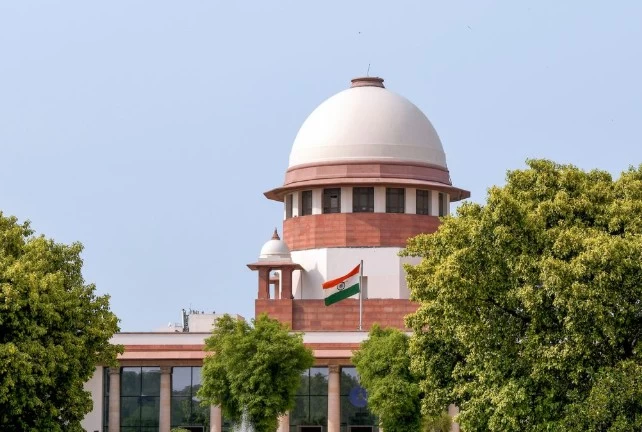
The Supreme Court on Thursday sought the Union government’s response to a plea demanding the time bound restoration of statehood to Jammu and Kashmir (J&K), but reminded petitioners that recent security events, such as the April 22 Pahalgam terror attack, could not be ignored in such considerations.
A bench led by Chief Justice of India B.R. Gavai, along with Justice K. Vinod Chandran, was hearing a petition seeking the implementation of the Supreme Court’s December 2023 judgment, which directed that Jammu and Kashmir’s statehood be restored “at the earliest opportunity” following Assembly elections. During the hearing, the bench observed, “You also have to take into consideration ground realities, and you cannot ignore what happened in Pahalgam in April,” referring to the terror attack in which 26 civilians were killed. It added, “We do not possess all the expertise, and there are some decisions that must be made by the government.”
The plea was filed by academic Zahoor Ahmad Bhat and social activist Khurshaid Ahmad Malik, through advocate Soyaib Qureshi. It urged the Court to direct the Centre to restore statehood within two months, arguing that J&K’s prolonged status as a Union Territory violated the basic structure of federalism in the Constitution.
Senior advocate Gopal Sankaranarayanan, appearing for the petitioners, read from the Court’s 2023 judgment on Article 370. He reminded the bench that the Court had then refrained from ruling on statehood only because the Solicitor General had assured it would be restored post-elections. “It has now been 21 months since that judgment. We seek a timeline, our plea says within two months, but we will accept whatever timeline the Court feels is appropriate,” Sankaranarayanan submitted.
Solicitor General Tushar Mehta, appearing for the government, opposed the plea, calling it “not maintainable”. He argued that the situation remained complex and that certain security and political considerations must inform such a significant move. “The elections were held. I don’t know why this issue is being agitated now. This is not the right time to muddy the waters,” Mehta told the bench. He added that he would seek instructions from the Centre and requested the matter be heard again after eight weeks.
The Court agreed, issuing notice to the government and posting the matter for a hearing two months later.
J&K was stripped of its special status and bifurcated into two Union Territories, Jammu and Kashmir, and Ladakh, on August 5, 2019, after the abrogation of Article 370.
In December 2023, a five-judge Constitution bench of the Supreme Court upheld the move, calling it a valid exercise of presidential power and a “culmination of integration” of J&K with India. The Court had then directed the Election Commission to ensure Assembly elections were held by September 2024.
The elections were conducted in three phases between September 18 and October 1, 2024, leading to the formation of a National Conference–Congress alliance government. Omar Abdullah, whose National Conference won 27 of the 42 seats, was sworn in as Chief Minister. However, despite the successful elections and relative calm during the Lok Sabha polls earlier in 2024, the Centre has not announced a timeline for restoring statehood.
The renewed demand for statehood has resurfaced in the shadow of the April 22 terror attack in Pahalgam, where three armed men from The Resistance Front, affiliated with Lashkar-e-Taiba, killed 25 tourists and a local pony operator after asking about their religious identity.
India responded with Operation Sindoor on May 7, launching precision strikes against terror camps in Pakistan and Pakistan-occupied Kashmir (PoK). Over four days of hostilities, the Indian Air Force targeted 13 Pakistani military installations, while Pakistan retaliated with cross-border attacks.
The conflict ended after an 88-hour standoff, with Islamabad reportedly requesting a ceasefire through diplomatic backchannels. By late July, the three terrorists involved in the Pahalgam attack were killed in a joint operation in Dachigam forest.
Chief Minister Omar Abdullah has consistently maintained that restoring statehood is a constitutional necessity. In early August, he wrote to leaders of 42 political parties, including Congress president Mallikarjun Kharge, urging them to introduce a Bill in Parliament during the Monsoon Session to reinstate full statehood. Abdullah insisted the move was not a political favour but a “course correction”, warning that continuing with Union Territory status would set a dangerous precedent for Indian federalism. “The precedent of downgrading a state can have unsettling consequences,” he said. Restoration of statehood had also featured as a core election promise by the INDIA bloc during the 2024 campaign.