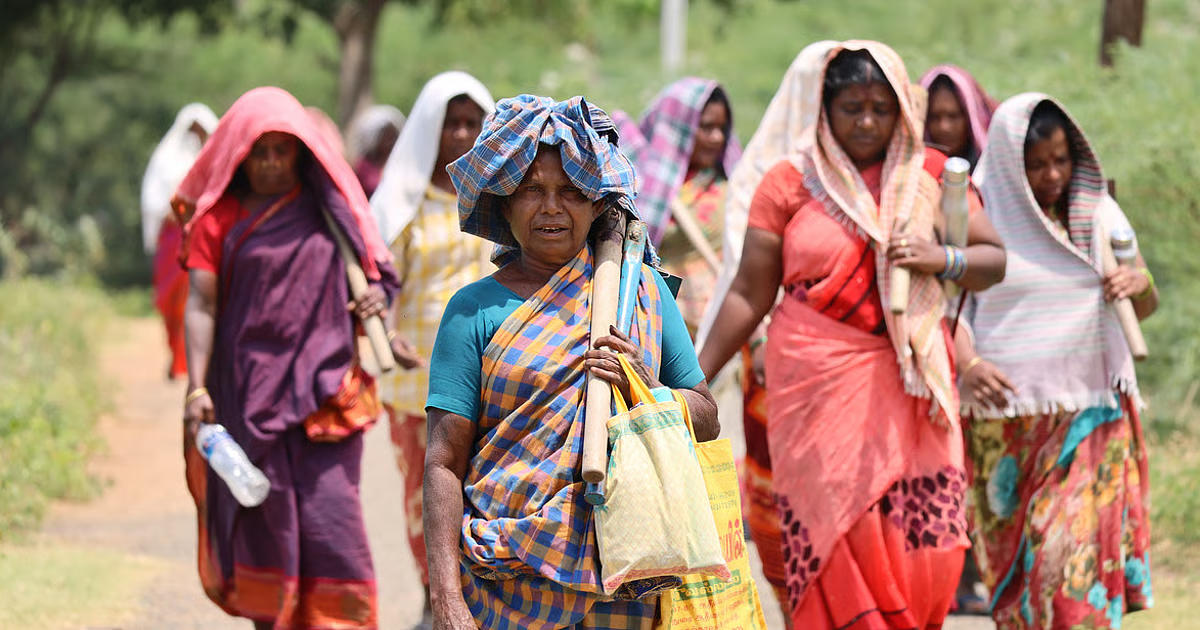
The Union government is all set to overhaul India’s flagship rural employment programme, with the Narendra Modi-led administration proposing to replace the Mahatma Gandhi National Rural Employment Guarantee Act, 2005 (MGNREGA) with a new scheme titled the Viksit Bharat—Guarantee for Rozgar and Ajeevika Mission (Gramin), or VB–G RAM G Bill, 2025.
According to the draft legislation, the proposed law seeks to create a new rural development framework aligned with the government’s long-term vision of Viksit Bharat @2047. It aims to provide a statutory guarantee of 125 days of wage employment each financial year to every rural household whose adult members are willing to undertake unskilled manual work.
The Bill states that the programme will focus on “empowerment, growth, convergence and saturation for a prosperous and resilient rural Bharat”, while also supporting the creation of a Viksit Bharat National Rural Infrastructure Stack through public works.
Unlike MGNREGA, which guarantees 100 days of work, the new scheme raises the entitlement to 125 days and places a strong emphasis on infrastructure creation. It will prioritise works related to water security, core rural infrastructure, livelihood-linked assets, and special projects to mitigate extreme weather events, the draft says.
However, the new framework significantly alters the funding structure. While the scheme will continue as a Centrally Sponsored Scheme, it requires greater financial participation from state governments. The Centre proposes a 90:10 cost-sharing formula for north-eastern and Himalayan states, including Uttarakhand, Himachal Pradesh and Jammu and Kashmir, and a 60:40 split for all other states and Union Territories with legislatures.
Under MGNREGA, the Union government bore the entire cost of the programme.
In a major departure from the existing law, the proposed Bill also prohibits employment works during peak agricultural seasons to ensure the availability of farm labour.
“Notwithstanding anything contained in this Act or rules made thereunder, and to facilitate adequate availability of agricultural labour during peak agricultural seasons, no work shall be commenced or executed under this Act, during such peak seasons as may be notified,” the Bill states.
The legislation retains the provision for an unemployment allowance if work is not provided on time. “If an applicant for employment under the Scheme is not provided such employment within fifteen days of receipt of his application… he shall be entitled to a daily unemployment allowance,” it says.
The governance structure of the scheme has also been reworked. The programme will be overseen by a newly constituted Central Gramin Rozgar Guarantee Council, set up by the Union government.
“The Central Council shall consist of a Chairperson, representatives of the Central Government and State Governments, not more than fifteen non-official members representing Panchayati Raj Institutions, organisations of workers and weaker sections of society, and a Member-Secretary not below the rank of Joint Secretary to the Government of India,” the Bill says.
This marks a shift from MGNREGA, which was administered directly by the Union Ministry of Rural Development without a separate statutory council.
At the state level, governments will be required to establish State Gramin Rozgar Guarantee Councils to regularly monitor and review the implementation of the Act.
In addition, the Centre will constitute a National Level Steering Committee to recommend decisions on normative allocations to states, advise on matters requiring inter-ministerial coordination, including convergence frameworks, and provide high-level oversight of the scheme. States will also set up their own steering committees.
The Bill continues to assign a central role to Panchayati Raj Institutions, designating panchayats at the district, intermediate and village levels as the principal authorities for planning, implementation and monitoring. District Programme Coordinators will be appointed to oversee execution on the ground.
The proposed legislation also gives the new law overriding powers over existing statutes.
“The provisions of this Act or the Scheme made thereunder shall have effect notwithstanding anything inconsistent therewith contained in any other law for the time being in force,” the Bill states.
However, it allows flexibility for states that already have employment guarantee laws. “Where a State Act exists or is enacted to provide employment guarantee for unskilled manual work to rural households consistent with the provisions of this Act… the State Government shall have the option of implementing its own enactment,” it adds.