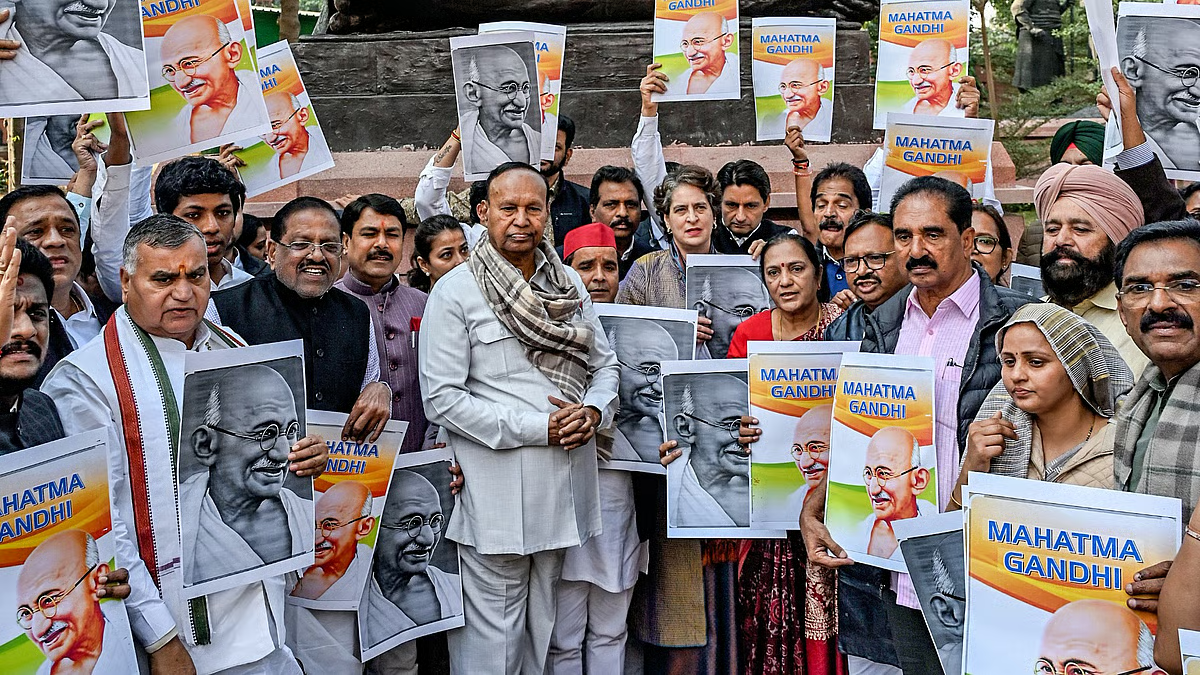
The Union Minister for Agriculture and Farmers Welfare, Shivraj Singh Chauhan, on Tuesday introduced the VB-G RAM-G Bill on rural employment in Parliament, proposing to replace the Mahatma Gandhi National Rural Employment Guarantee Act (MGNREGA) that was enacted during the UPA government’s tenure.
The proposed legislation immediately drew sharp criticism from opposition parties, which described the move as an attack on the constitutional spirit of the existing employment guarantee framework and a dilution of workers’ rights.
Speaking in the Lok Sabha, Congress leader Priyanka Gandhi strongly opposed the bill, stating that MGNREGA has played a vital role in strengthening the rural economy over the past two decades. She reminded the House that the Act was originally passed with broad parliamentary consensus and guarantees 100 days of employment to the poorest citizens based on demand. She argued that the new bill undermines this demand-driven structure, increases central control, reduces rights, and makes no provision for wage enhancement. According to her, the proposed changes go against the fundamental values enshrined in the Constitution. She also questioned the government’s intent behind repeatedly renaming welfare schemes that require substantial public expenditure and urged that the bill not be passed without detailed discussion.
Congress MP K.C. Venugopal, while objecting to the bill, termed it a “fundamental attack on the Constitution.” Addressing the Agriculture Minister directly, he said MGNREGA represents a legal right to employment for ordinary citizens. He criticised the proposal to remove Mahatma Gandhi’s name from the scheme, calling it deeply ironic at a time when the Prime Minister frequently invokes Gandhi’s legacy. Venugopal alleged that the move would be remembered as an attempt to erase the Father of the Nation’s association with one of India’s most significant social welfare programmes.
Adding to the criticism, MP Shashi Tharoor said the bill amounted to an assault on the spirit of MGNREGA and Mahatma Gandhi’s vision of Ram Rajya. He argued that Gandhi’s idea of Ram Rajya was never a political slogan but a socio-economic framework centred on village empowerment. Tharoor objected to the removal of Mahatma Gandhi’s name and questioned the proposed financial restructuring, particularly the requirement for states to bear 40 per cent of the programme’s cost. He cautioned that such a provision could render the scheme unworkable, weaken federal principles, and ultimately lead to its destruction.
NCP (Sharadchandra Pawar faction) MP Supriya Sule opposed the removal of Mahatma Gandhi’s name, stating that while schemes can be updated, such changes must follow proper parliamentary scrutiny. She also added that effective implementation matters more than renaming programmes, which does not guarantee better results.