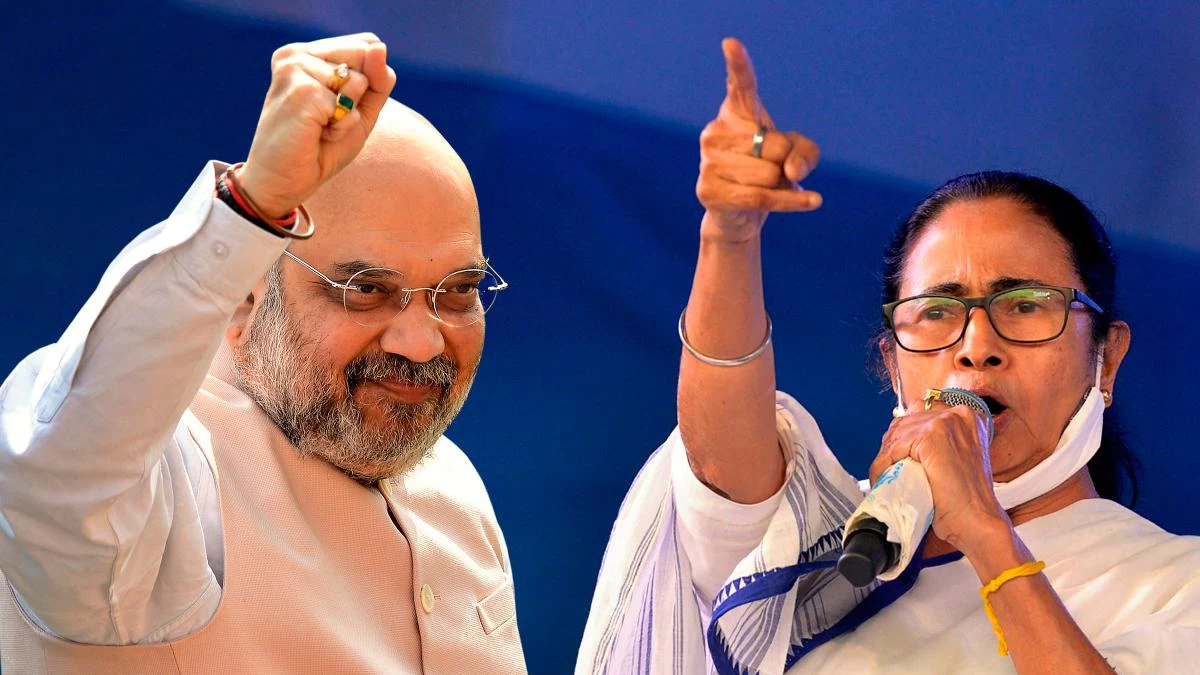
West Bengal Chief Minister and Trinamool Congress leader Mamata Banerjee has issued a scathing condemnation of the Constitution (130th Amendment) Bill, 2025, introduced in the Lok Sabha by Union Home Minister Amit Shah. The bill, which proposes amendments to Article 75 of the Indian Constitution, seeks to remove central or state ministers, including the Prime Minister or Chief Ministers, who face allegations of corruption or serious offenses and have been detained for at least 30 days. Banerjee, however, has described the legislation as a "draconian step" that threatens the core of India’s democratic framework and federal structure.
In a post on X, Banerjee labeled the bill as "more than a super-Emergency" and a "Hitlerian assault on the very soul of Indian democracy." She argued that the proposed amendment undermines the judiciary’s independence by stripping courts of their constitutional role to adjudicate matters of justice and federal balance. "This Bill now wants to finish the Independence of our Judiciary," Banerjee stated, warning that it vests excessive power in "partisan hands," thereby mutilating democratic principles. She further criticized the bill as a move toward regression, stating, "This is not reform. This is regression - towards a system where the law no longer rests with independent Courts but is placed in the hands of vested interests."
Banerjee also expressed alarm over the bill’s potential to suppress voting rights under the guise of a Special Intensive Revision (SIR). She described this as "another super-draconian step by the Centre," accusing the government of attempting to consolidate power in a manner reminiscent of authoritarian regimes. "This is how authoritarian regimes, even fascist ones in history, consolidated power. It reeks of the very mindset that the world once condemned in the darkest chapters of the 20th century," she wrote.
The Chief Minister highlighted the bill’s implications for federalism, alleging that it empowers unelected central agencies like the Enforcement Directorate (ED) and Central Bureau of Investigation (CBI) - which she referenced as "caged parrots," echoing a Supreme Court description- to interfere in the functioning of elected state governments. "The Bill seeks to empower the Union to intrude upon the mandate of the people, handing sweeping powers to unelected authorities," Banerjee asserted, emphasizing that it undermines the basic structure of the Constitution, including federalism, separation of powers, and judicial review.
Banerjee’s remarks come in the context of heightened political tensions, with several opposition leaders echoing her concerns. For instance, Rashtriya Janata Dal (RJD) MP Manoj Jha described the bill as a tactic to destabilize non-BJP state governments. The bill’s introduction has also sparked protests from opposition leaders, including Congress MP Gaurav Gogoi and Trinamool Congress MP Mahua Moitra, who view it as an attempt to distract from other political movements, such as Rahul Gandhi’s Vote Adhikar Yatra.
The 130th Constitutional Amendment Bill is one of three bills introduced by the government, alongside the Government of Union Territories (Amendment) Bill, 2025, and the Jammu and Kashmir Reorganisation (Amendment) Bill, 2025. These bills aim to address gaps in current laws, which lack clear provisions for removing high-ranking officials detained on serious charges. However, critics like Banerjee argue that the legislation risks centralizing power and eroding democratic safeguards.
Banerjee concluded her statement with a call to action, urging resistance against the bill to protect India’s Constitution and democratic values. "The Bill must be resisted at any cost! Democracy must be saved at this moment! The people will not forgive any attempt to take away their Courts, their rights, and their democracy," she declared, ending with a patriotic "Jai Hind!"
The bill is referred to a Joint Parliamentary Committee for further deliberation, its passage remains a contentious issue, with opposition leaders like Banerjee vowing to fight what they see as an overreach by the central government.