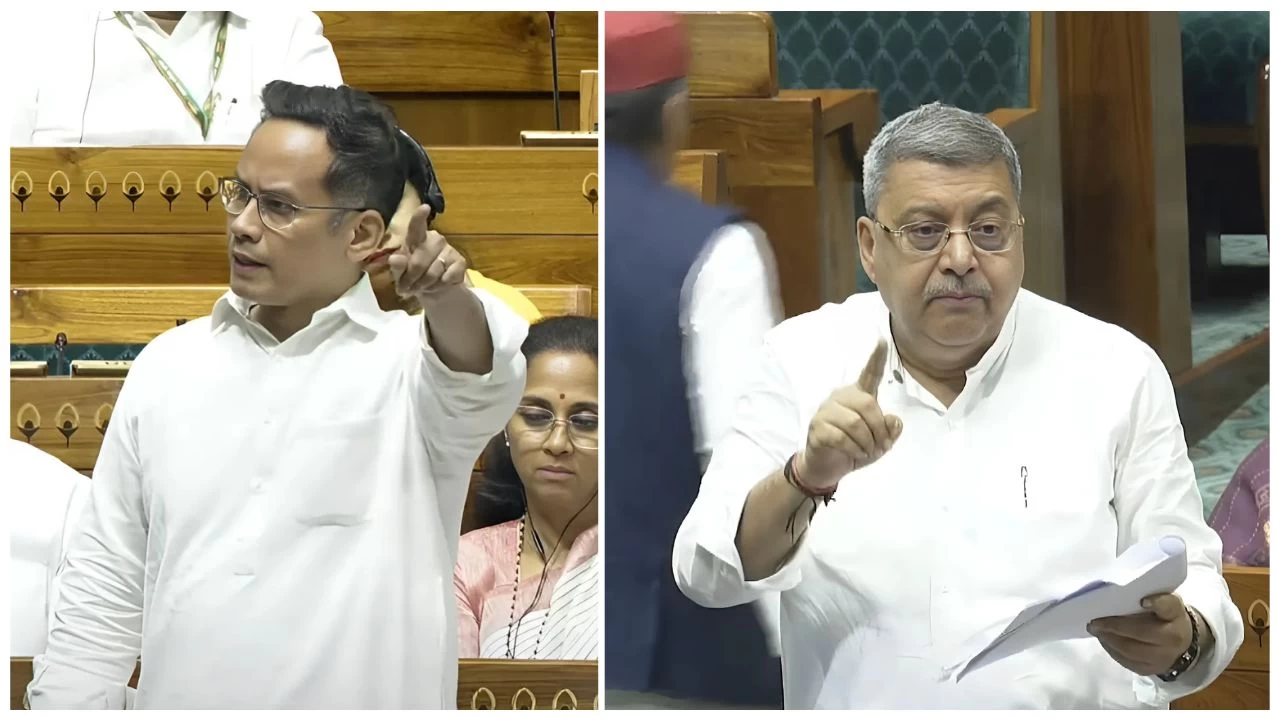
The Lok Sabha on Monday witnessed a fiery debate on Operation Sindoor, India’s military response to the April 22, 2025, Pahalgam terror attack that claimed 26 lives, mostly tourists. Opposition leaders, led by Congress MP Gaurav Gogoi and Trinamool Congress (TMC) MP Kalyan Banerjee, sharply criticised the Modi government, raising pointed questions about security lapses, the operation’s outcomes, and the controversial ceasefire with Pakistan.
Gaurav Gogoi’s Scathing Critique
Congress Deputy Leader in the Lok Sabha, Gaurav Gogoi, led the Opposition’s charge, delivering a speech that challenged the government’s narrative on Operation Sindoor. Gogoi zeroed in on the Pahalgam attack, questioning how five Pakistani terrorists infiltrated a high-tourist area despite India’s advanced security apparatus, including drones, satellites, and forces like the CRPF and BSF. “Rajnath Singh ji gave a lot of information, but as Defence Minister, he never mentioned how terrorists from Pakistan reached Pahalgam and killed 26 people. It is our duty to ask these questions in the interest of the nation,” Gogoi said, emphasising the need for transparency.
Gogoi pressed Rajnath Singh on reported losses during the operation, citing claims by US President Donald Trump that five to six fighter jets were downed. “If some Rafale jets have been downed, I think it is a big loss. We want to know from Rajnath Singh ji today how many of our fighter jets were downed. We must tell the truth not just to the public but also to our jawans, who are being lied to,” he asserted. He referenced an alleged statement by India’s defence attaché to Indonesia, Captain Shiv Kumar, suggesting that losses occurred due to political constraints limiting strikes to terrorist infrastructure and avoiding Pakistani military targets.
The Congress MP also questioned the abrupt ceasefire announced on May 10, asking, “The entire country and the Opposition were supporting PM Modi. Suddenly, we got to know there had been a ceasefire. Why? If Pakistan was ready to kneel down, then why did you stop, and to whom did you surrender?” Gogoi highlighted Trump’s repeated claims of mediating the ceasefire, demanding clarity on whether India bowed to external pressure. He further criticised the government’s foreign policy, noting that the BRICS summit condemned the Pahalgam attack but not Pakistan explicitly, and questioned the lack of action against Pakistan’s financial aid from global bodies like the IMF and ADB.
In a direct jab at the Home Ministry, Gogoi argued that Union Home Minister Amit Shah and the central government could not “hide behind the Lieutenant Governor” of Jammu and Kashmir who in an interview has taken responsibility of the lapses and the intelligence failure. He pointed to the delayed response during the Pahalgam attack, noting that it took nearly an hour for an ambulance to reach Baisaran, reflecting poorly on local security coordination. “The government told us that after Article 370’s abrogation, it was safe to go to Kashmir. But what happened in Baisaran?” he asked, challenging the government’s claims of improved security.
Kalyan Banerjee’s Chowkidar Remark
TMC MP Kalyan Banerjee amplified the Opposition’s critique, focusing on the ceasefire and the government’s perceived silence in the face of international claims. In a fiery statement, Banerjee questioned Prime Minister Modi’s response to US President Trump’s assertions of brokering the ceasefire. “PM Modi, why couldn’t you post on your ‘X’ handle that whatever the American President said is incorrect? The moment you stand in front of the American President, your height is reduced to 5 feet, and your chest is reduced to 36 inches from 56 inches. Why are you so afraid of the American President?” he said, drawing sharp reactions from the ruling benches.
Banerjee praised the armed forces for Operation Sindoor’s success but questioned the government’s accountability for the Pahalgam attack. “How could four terrorists come, kill people, and walk back to Pakistan so easily? Where were BSF, CRPF, Home Minister?” he asked, echoing Gogoi’s concerns about intelligence failures. He likened the ceasefire to “declaring an innings at 90,” suggesting that India stopped short of fully capitalising on its military advantage. “Have you ever seen any player in cricket who was targeting century, would call off the match at 90. After scoring 90, will anyone surrender”, he questioned, reiterating the opposition demand for a convincing explanation as why India went for ceasefire when the military operation was a success. He mocked the Prime Minister reminding his previous speech inside the parliament where he called himself the chowkidar (guard). “PM would call himself a guard who was guarding the country. What kind of a guard are you when some terrorists enter the country and kill people without being checked. We are better off than without such a chowkidar”, he said. He slammed the government for not taking the appropriate revenge from Pakistan after 26 families have been shattered, stating “I was waiting for the news that India will take back PoK but instead got the news of ceasefire.
Rajnath Singh’s Claim
Defence Minister Rajnath Singh, who initiated the debate, defended Operation Sindoor as a testament to India’s “decisive strength” and “moral clarity” under Prime Minister Narendra Modi’s leadership. He outlined the operation’s success in targeting nine terror camps without harming Pakistani civilians, emphasising India’s restraint and adherence to Article 51 of the UN Charter. Singh rebuffed Gogoi’s questions about aircraft losses, calling them misaligned with national sentiment. “Few members of the Opposition have been asking how many of our aircraft were shot down? I feel their question does not adequately represent our national sentiments. They have not asked us how many enemy aircraft our Armed Forces shot down,” he retorted, accusing the Opposition of fault-finding.
Singh also clarified that Operation Sindoor was “paused, not ended,” and India would resume strikes if Pakistan resorted to further provocations. He reiterated the government’s stance that “talks and terror cannot go together,” citing previous operations like the 2016 surgical strike and the 2019 Balakot air strike as evidence of India’s evolving strategy against terrorism. Singh paid tribute to the armed forces, asserting that India’s actions had rattled Pakistan’s terror infrastructure.
Gogoi, however, remained unyielding, accusing Singh of sidestepping critical questions about the Pahalgam attack’s origins and the ceasefire’s rationale. “Rajnath Singh says we dismantled terror infrastructure after Pulwama, Uri. Then how did the terrorists come to Baisaran?” he asked, highlighting what he described as a cycle of unaddressed security lapses.
Jaishankar’s Clarification on Foreign Policy
External Affairs Minister S. Jaishankar addressed the Opposition’s concerns about international mediation and India’s global standing. Responding to Gogoi and Banerjee’s references to Trump’s claims, Jaishankar categorically denied any foreign mediation in the ceasefire. “No conversation took place between PM Modi and President Trump from April 22 to June 17,” he stated, rejecting the US President’s assertions of intervening 26 times. Jaishankar emphasised that the ceasefire was a bilateral decision between India and Pakistan, with no external pressure involved. Jaishankar also highlighted India’s diplomatic efforts post-Operation Sindoor, noting that multi-party delegations, including those led by Congress MP Shashi Tharoor, had briefed over 30 world capitals on India’s counterterrorism stance. He cited condemnation of the Pahalgam attack by international groupings like BRICS and Quad, underscoring global support for India’s actions. “There was no conversation on trade during our talks with the US on Pahalgam,” he added, countering Gogoi’s claims about India’s foreign policy weaknesses.
Operation Sindoor, launched on May 7, 2025, was India’s retaliatory strike against terrorist infrastructure in Pakistan and Pakistan occupied Kashmir, targeting groups like Lashkar-e-Taiba and Jaish-e-Mohammed following the Pahalgam attack. The operation, described by the government as a precise and swift 22-minute strike, reportedly neutralised over 100 terrorists across nine locations. The debate, part of the ongoing Monsoon Session, followed a week of disruptions over issues like the Special Intensive Revision (SIR) of electoral rolls in Bihar.